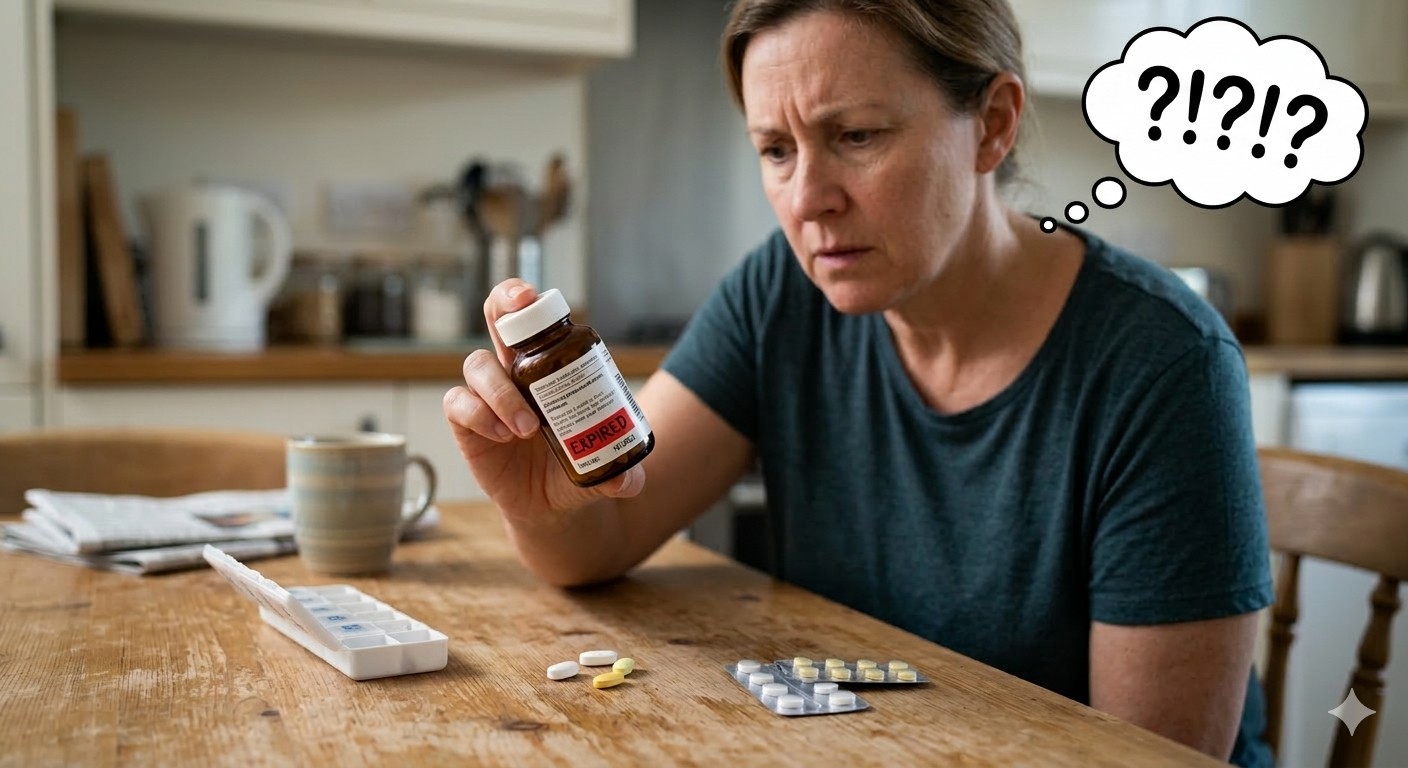
It is easy to understand why medication expiration often feels like a dilemma. On one hand, medicines can be expensive, and discarding them immediately after the printed date may seem wasteful. On the other hand, using medication that might have lost potency raises understandable concerns about safety and effectiveness. Many people therefore wonder whether medication expiration dates represent a strict boundary between safe and unsafe use, or whether they are simply cautious guidelines1.
The answer lies somewhere in between. In most cases, an expiration date marks the period during which the manufacturer guarantees the drug’s stability and potency under recommended storage conditions. Once that period ends, the reliability of the medication becomes less certain. For some drugs, this uncertainty may not have serious consequences; however, for others, even a modest decline in potency following medication expiration can significantly affect treatment. Understanding what expiration dates represent therefore requires examining how drug stability is measured, how medications degrade over time, and why risks vary between different formulations.
The legal and regulatory meaning of medication expiration
An expiration date is not simply a suggestion printed on packaging. Rather, it represents the period during which the manufacturer certifies that the medication will remain both safe and fully potent when stored according to the instructions on the label. Regulatory authorities require pharmaceutical companies to establish this timeframe through stability testing before a drug can be approved for sale.
Once the medication expiration date has passed, the drug may still contain active ingredients, but the manufacturer can no longer assure consistent strength or stability. In this sense, the expiration date represents the boundary of confirmed reliability rather than an abrupt transition from safe to unsafe.
The science of drug stability and what happens to medication over time
Pharmaceutical standards generally require that medications retain at least 90% of their labeled potency until the date of medication expiration2. This threshold ensures that patients receive a dose close enough to the intended amount for reliable therapeutic action.
Chemical degradation and gradual loss of potency
Over time, however, chemical reactions gradually break down the active pharmaceutical ingredient. Processes such as oxidation, hydrolysis, and photodegradation slowly alter the structure of the drug molecule, which leads to the formation of smaller chemical compounds3. As degradation progresses, the concentration of the original active compound declines.
If the resulting breakdown products are chemically harmless, the primary consequence of medication expiration is reduced potency. In practical terms, the medication behaves like a weaker version of the original drug because a portion of the active compound has already decomposed. The patient therefore receives a smaller effective dose than originally intended, which may lead to reduced therapeutic benefit.
This decline usually occurs gradually rather than abruptly4. Medications do not suddenly become unsafe immediately after the expiration date; instead, their stability slowly decreases as the active ingredient continues to degrade. Nevertheless, even modest reductions in potency can be clinically significant when a medication must deliver a precise dose to treat a serious condition, a concept central to the field of precision medicine.
Degradation does not always produce harmless by-products, however. In some cases the newly formed compounds may irritate tissues or produce unwanted effects. Aspirin provides a well-known example: over time it hydrolyzes into acetic acid, which produces a vinegar-like odor and may increase stomach irritation when ingested5.
Physical changes and factors that affect stability
Chemical degradation may also be accompanied by visible physical changes in the medication. Tablets can become brittle, discolored, or crumbly as their internal structure deteriorates. Creams and ointments may separate into oily and watery layers, while liquid formulations may turn cloudy or develop sediment.
At the same time, not all degradation produces obvious visual signs. In many cases the chemical composition of the drug may change while the tablet or solution appears outwardly normal. The absence of visible deterioration therefore does not guarantee that a medication remains fully potent6.
The rate at which these changes occur varies considerably depending on formulation, packaging, and storage conditions3. Exposure to heat, humidity, or light can accelerate chemical breakdown. As a result, medications stored in bathrooms, vehicles, or other environments with fluctuating temperatures may deteriorate faster than those kept in cool, dry, and stable conditions.
How expiration dates are determined
Understanding the meaning of expiration dates also requires examining how those dates are established in the first place. Pharmaceutical shelf life is not chosen arbitrarily; rather, it is determined through structured stability studies designed to evaluate how medications behave under different environmental conditions3.
Stability testing
To determine how long a medication remains stable, manufacturers conduct controlled stability studies. During these studies, samples of the drug are stored under specific environmental conditions while scientists periodically measure the concentration of the active ingredient. These measurements allow researchers to observe how quickly the chemical structure degrades over time3.
Environmental factors are carefully controlled during these tests because they strongly influence degradation rates3. Moisture can trigger hydrolysis reactions that break down certain compounds, while heat accelerates chemical reactions that destabilize others. Light exposure can also initiate photochemical reactions that degrade sensitive molecules.
Accelerated aging models
Because long-term stability testing can take several years, scientists often rely on accelerated aging techniques to estimate shelf life more efficiently7. In these experiments, medications are stored at elevated temperatures in order to speed up degradation reactions.
Researchers then apply chemical kinetics models to extrapolate how the drug would degrade under normal storage conditions. These models rely on the principle that chemical reaction rates increase with temperature, and modern researchers are even exploring the use of artificial intelligence to better predict these stability outcomes within shorter testing periods.
Economic and practical considerations
Although stability science provides the foundation for expiration dating, practical considerations also influence the final labeled shelf life. Extending shelf life requires prolonged monitoring and additional regulatory documentation. Conducting studies that track stability for ten years or longer would significantly increase development costs and delay product release8.
For this reason, many medications receive expiration periods of two to three years even when longer stability might be possible9. This conservative approach provides a safety margin while allowing manufacturers to maintain efficient production cycles.
Why expired medications do not all carry the same risk
Although most medications degrade gradually, the consequences of degradation vary significantly depending on the formulation and intended use. Some medications remain relatively stable for long periods, while others are far more sensitive to environmental conditions4.
High-risk categories
Certain medications should not be used after expiration because degradation can introduce additional safety concerns beyond simple potency loss.
Injectable medications and other sterile preparations require strict sterility to prevent infection. Once the expiration date passes, sterility can no longer be guaranteed. Even a small risk of contamination can have serious consequences when a drug is injected directly into the bloodstream.
Biologic medications, including insulin and monoclonal antibodies used in advanced immunotherapy, present another challenge10, 11. These drugs consist of complex protein molecules whose function depends on precise three-dimensional structures. Over time, these proteins may denature or aggregate, which reduces their biological activity. Because biologics rely on structural integrity, even subtle degradation following medication expiration can significantly reduce therapeutic effectiveness.
Liquid suspensions and solutions are also more vulnerable to instability. Water facilitates many chemical reactions that degrade active ingredients, and microbial growth becomes more likely as preservatives gradually lose effectiveness12.
Eye drops present a similar concern13. Preservatives that prevent bacterial growth can break down over time, which increases the risk of infection when the drops are applied to sensitive ocular tissues.
Medications with critical potency requirements
Some medications remain chemically stable for longer periods but still require precise potency to function effectively.
Nitroglycerin, which is used to relieve angina, is particularly sensitive to environmental exposure14. Even moderate potency loss may reduce its ability to relieve chest pain during a cardiac emergency.
Epinephrine auto-injectors provide another example15. These devices deliver epinephrine during severe allergic reactions, and the medication must act quickly to reverse life-threatening symptoms. Because epinephrine gradually degrades over time, an expired injector may deliver a weaker dose than intended.
Antibiotics also require adequate potency to eliminate bacterial infections effectively16. If the dose is too weak because of degradation, treatment may fail. In addition, insufficient drug levels can contribute to the development of antibiotic resistance17. This is especially critical in veterinary contexts, as sub-therapeutic dosing in animals can lead to the persistence of pathogens and an increased risk of zoonotic disease transmission to humans. Addressing these interconnected risks, where the quality of animal medicine directly impacts human safety, is a fundamental component of the One Health approach.
Lower-risk medications
In contrast, many solid oral tablets such as common pain relievers and antihistamines tend to remain chemically stable when stored in cool, dry environments4. In these cases, the primary issue is gradual potency loss rather than toxicity. While the medication may become less effective over time, the risk of harm is generally low when these drugs are used for non-critical conditions.
The debate over shelf-life extension
Because many medications degrade slowly, researchers have investigated whether certain drugs remain usable beyond their labeled expiration dates. Large-scale stability reassessment programs have provided valuable insights into this question.
One notable example is the Shelf Life Extension Program conducted by the U.S. Food and Drug Administration in collaboration with the U.S. Department of Defense18. This program evaluates stockpiled medications that are stored for emergency preparedness and national defense purposes19.
Testing conducted through this initiative has shown that many medications retain acceptable potency several years beyond their original medication expiration dates when stored under carefully controlled conditions20. These findings suggest that expiration dates are often conservative.
However, it is important to recognize that these extensions apply only to specific batches that have undergone laboratory testing. The results therefore cannot be generalized to medications stored under unknown conditions.
The risk of expiration label tampering
In rare cases, medication labels may be altered to extend the apparent shelf life of a product. Legitimate shelf-life extensions are sometimes authorized by regulatory agencies after stability testing of specific batches. However, relabeling without regulatory approval—such as replacing or covering expiration dates in pharmacies, informal markets, or supply chains—is unethical and potentially dangerous21. For this reason, it is good practice to check the expiration date and packaging integrity when purchasing medicines. Patients should obtain medications from reputable sources and avoid products with damaged, overwritten, or suspicious labels.
Practical recommendations for medication use
Considering these factors, medication expiration dates should be viewed as practical guides for safe medication use rather than arbitrary warnings8. They mark the period during which a medication’s stability and potency are guaranteed, rather than the point at which it immediately becomes harmful.
For non-critical medications, particularly solid tablets stored in cool and dry conditions, short periods beyond the expiration date may carry relatively low risk20. In such cases the primary concern is reduced potency, which means the medication may simply work less effectively because some of the active ingredient has degraded.
However, medications used to treat serious or life-threatening conditions should ideally be replaced before the medication expiration date. Drugs used for cardiac conditions, severe allergies, seizures, or infections require reliable potency to achieve their intended therapeutic effect, and weakened doses may compromise treatment14.
Similarly, injectable medications, biologics, liquids, and sterile preparations should not be used after expiration because the risks associated with degradation or contamination are substantially greater.
That said, real-world circumstances are not always ideal. During emergencies, humanitarian crises, military conflict, or in settings where access to medicines is limited—as may occur in some developing regions—expired medications may sometimes be used when no alternatives are available19, 3. In such situations, understanding that most degradation primarily reduces potency rather than instantly creating toxicity can help guide cautious decisions. However, it remains important to recognize that replacement with properly stored, in-date medication is the safest option whenever possible.