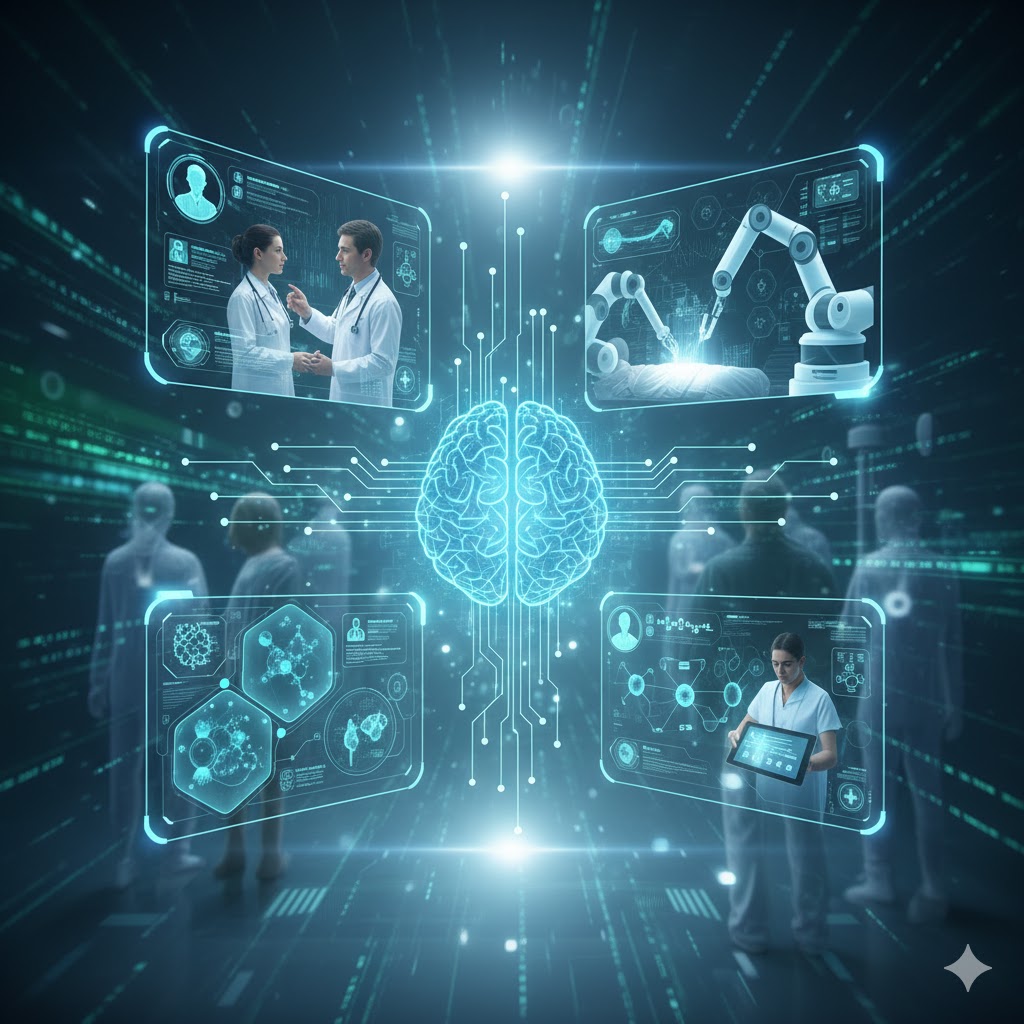
Artificial intelligence (AI) refers to the technology that enables computers and machines to simulate human cognitive functions such as learning, problem-solving, pattern recognition, decision-making, and even creativity1. Machine learning (ML), which is a core branch of AI, creates statistical models to learn from data for identifying patterns and making predictions without the requirement for dedicated programs to run each task2.
Deep learning, a further subset of ML, uses artificial neural networks modeled after the human brain’s structure to process complex and unstructured data such as images or natural language3.
In healthcare and biological research, AI and ML have become indispensable tools for analyzing vast, complex datasets with unprecedented speed and accuracy, making it possible to execute tasks in a way that no human can do4. These capabilities are translating into improvements in disease diagnosis, personalized treatment, drug discovery, workflow optimization, and much more4-7.
AI in disease diagnosis and medical imaging
AI algorithms have the superior capability to recognize patterns, which is proving to be highly useful in the analysis of medical images such as X-rays, CT scans, MRIs, ultrasound, and pathology slides8-12. Deep learning models trained on vast, annotated datasets have shown accuracy in detecting cancers, cardiovascular abnormalities, neurological lesions, fractures, and infections in ways that often surpass the performance of human experts13-17. For instance, Google’s DeepMind and Aidoc support radiologists by providing rapid, precise triaging of emergency cases18. Similarly, PathAI aids pathologists in tumor grading and biomarker quantification19. Radiology and pathology workflows augmented by AI are helping to reduce diagnostic errors, interobserver variability, and time-to-diagnosis, making earlier interventions possible with improved patient outcomes. AI-powered multimodal approaches are integrating imaging with genomic and clinical data, making it possible to deliver comprehensive diagnostics tailored to individual patients.
Personalized medicine and treatment optimization
AI is making truly personalized medicine a reality by synthesizing heterogeneous data sources across genomics, proteomics, metabolomics, electronic health records (EHRs), and patient lifestyle, to predict disease risk, drug response, and adverse effects20-22. Oncology has particularly benefited from AI-guided therapies that help to match treatments to tumor mutational profiles, optimize immunotherapy regimens, and minimize toxicities23.
Precision dosing platforms are also using AI models to adjust drug doses dynamically by integrating vital signs and biochemical data24.
Wearable AI sensors, on the other hand, are facilitating remote health monitoring for chronic disease management25. This helps to predict exacerbations in diseases like diabetes and heart failure well before clinical symptoms worsen, thereby reducing hospitalizations26, 27.
Drug discovery and development
Adoption of AI is helping to accelerate all phases of drug discovery, from target identification and molecular design to preclinical testing and clinical trials6. ML models help to rapidly screen chemical libraries for promising candidates, predict protein-ligand binding affinities, and optimize pharmacokinetic and toxicity profiles28.
Breakthroughs such as AlphaFold have revolutionized rational drug design by solving the critical challenge of protein folding prediction29.
In clinical trials, AI optimizes patient recruitment by matching molecular and clinical profiles to trial criteria30. It is also used to monitor patient safety in real time and predict efficacy patterns31. These innovations have significantly lowered costs, shortened timelines, and increased success rates of drug development pipelines.
Robotic-assisted surgery and automation
AI-powered robotic systems are being used to enhance surgical precision32. This has offered the benefits of reduced invasiveness and improved patient recovery. These systems integrate real-time imaging and AI-based motion prediction to assist surgeons in complex tasks like resections and microsurgery.
Robotic rehabilitation devices customize physical therapy by interpreting patient movement data and adapting exercises to individual needs33.
In research and clinical laboratories, AI-driven automation streamlines workflows, including sample preparation, sequencing, and high-throughput screening34. This provides unmatched benefits by minimizing human error and increasing throughput and reproducibility.
Clinical decision support and workflow enhancement
AI-powered clinical decision support systems combine structured EHR data and unstructured clinical notes via natural language processing to provide actionable insights35. These systems assist clinicians in diagnosis, risk stratification, and guideline adherence, thereby helping to reduce cognitive overload and errors.
AI automates administrative workflows such as scheduling, billing, and documentation. This helps clinicians to focus on patient care. AI chatbots and virtual health assistants offer 24/7 symptom triage, medication reminders, and mental health support, which is helping to expand access and engagement36. Hospitals are also increasingly using AI for resource forecasting and patient flow optimization in order to improve operational efficiency.
Error reduction and quality assurance
AI systems are used to actively audit clinical and operational processes by continuously analyzing real-time data streams across the healthcare system. This constant vigilance is essential for flagging potential errors, deviations, or safety risks as they occur, which potentially enhances patient safety, reduces adverse events, and maintains high standards of care quality. For example, they are useful in areas such as medication error detection, imaging quality control, and monitoring complex surgical procedures32, 37-38. In addition, automated data analysis supports crucial administrative tasks, including ensuring regulatory compliance and billing accuracy.
AI in biological research and laboratory sciences
In life sciences, AI’s ability to analyze vast multi-omics datasets is helping in the discovery of novel biological pathways, disease mechanisms, and therapeutic targets. ML models, on the other hand, are helping to reconstruct gene regulatory networks and predict protein interactions39, 40. AI is also facilitating the optimization of CRISPR guide RNA design for precise genome editing, thereby helping to reduce off-target effects41.
Ecology and biodiversity studies benefit from AI-powered image recognition and environmental sensor data integration to track species and monitor ecosystems42. In synthetic biology, AI helps to predict metabolic pathways and simulate cellular behaviors43, 44.
Population health and epidemiology
In public health, AI is being used for its ability to analyze vast data streams for disease management and crisis response. By integrating data from sources like social media, electronic health records, and environmental sensors, AI models can detect outbreaks, monitor the spread of antimicrobial resistance, and forecast healthcare demand45. These predictive capabilities are crucial for supporting and optimizing strategies related to vaccination and other public health interventions.
The utility of AI was clearly visible during the COVID-19 pandemic, where it was used for rapid contact tracing, accelerated diagnostic test development, and facilitated effective remote patient monitoring46. These truly showcased its indispensable potential in managing large-scale public health crises.
Examples of AI impact and tools
- Radiology: Aidoc and Tempus Radiology provide AI solutions for various imaging modalities.
- Oncology: IBM Watson Oncology and Foundation Medicine deliver AI-driven precision treatment recommendations.
- Cardiology: AliveCor offers AI-based ECG monitoring, predicting arrhythmias and heart attacks.
- Infectious disease: BlueDot uses AI to monitor global health threats.
- Drug discovery: Atomwise and BenevolentAI utilize AI for rapid compound screening and design.
- Virtual care: Babylon Health and Ada provide AI symptom assessment and triage47.
- Wearable monitoring: Biofourmis and Philips IntelliVue Guardian offer AI-powered predictive health monitoring devices.
Challenges and ethical considerations
While AI holds great promise in healthcare, several key challenges and ethical considerations need careful attention for its safe, effective, and equitable adoption.
- Data privacy and security stand out as fundamental issues since healthcare data contains sensitive personal information protected by strict legal standards like Health Insurance Portability and Accountability Act of 199648. Protecting this data from breaches, unauthorized access, or misuse requires robust encryption, secure storage, and strict compliance with regulations.
- Another challenge is the “black box” nature of many AI algorithms, especially deep learning models, which produce predictions without clear explanations49. This lack of transparency can undermine clinician and patient trust and complicate clinical decision-making. It is therefore essential to develop efficient explainable AI models to provide understandable rationales for AI outputs, as this will also facilitate regulatory approvals.
- Bias and fairness are also critical concerns50. AI systems trained on datasets lacking diversity may unintentionally perpetuate or even amplify healthcare disparities. Ensuring representative training data, continuous evaluation across populations, and incorporating fairness criteria during model development are necessary to mitigate these risks.
- Integrating AI into complex healthcare ecosystems requires overcoming interoperability challenges between diverse electronic health record systems, legacy infrastructure, and workflows51. For AI tools to be successfully integrated, standardizing processes, training clinicians, and managing organizational changes are essential so that these technologies enhance care instead of causing disruptions.
- Ethically, ensuring informed patient consent for AI-assisted care is a must, with transparent communication about the role of AI52. Clear liability frameworks are evolving to clarify responsibility in cases where AI-supported decisions result in harm. In addition, ensuring equitable access to AI technologies is essential to avoid widening health disparities.
- Continuous monitoring and validation of AI systems in real-world settings, alongside engagement with clinicians, ethicists, and patients, will ensure that they are being deployed responsibly and will increase trust in AI-enabled healthcare53.
Future prospects
The integration of AI is revolutionizing healthcare, and is set to create a more personalized, efficient, and sophisticated medical ecosystem.
- AI will create autonomous health assistants to manage routine patient care and scheduling and thereby will make the system more efficient54.
- AI-augmented medical education will personalize clinician training55. This will also be complemented by augmented reality for enhancing surgical training and real-time intervention guidance56.
- The development of digital twins (virtual patient models) will allow doctors to simulate and optimize therapies, in order to provide highly personalized treatment57.
- AI will significantly expand the capabilities of virtual care and telehealth and thereby will make quality medical consultations more accessible58.
- Advanced multimodal data fusion combining genomics, imaging, proteomics, and patient data will unlock deep biological insights59. This will make it possible to provide precision medicine tailored to individual molecular profiles.
Conclusion
Artificial intelligence has proved to be a pathbreaking technology that is offering us peeks into the next era in healthcare and biological research. It enables advancements that improve diagnostics, personalize therapy, accelerate discovery, and optimize healthcare delivery. With its superior ability to harness vast data, AI is allowing us to make a shift towards predictive, preventive, and participatory medicine, with enhanced outcomes and accessibility. Multidisciplinary cooperation and ethical stewardship are however crucial to ensure that AI’s transformative potential benefits global health equitably.