The urgent need for organ alternatives
The global demand for life-saving organs far exceeds the current supply available from human donors. Thousands of patients remain on waiting lists for years, and many individuals unfortunately pass away before a match is found. This critical shortage has pushed scientists to look beyond human-to-human transplantation, and xenotransplantation has emerged as a hopeful solution1. This process involves the transplantation of living cells or organs from one species to another. Pigs have become the primary focus of this research, which helps to bridge the gap between supply and demand2.
Why pigs?
Pigs are considered ideal candidates for this procedure due to their physiological similarities to humans. Their organs are roughly the same size as ours, and they can be bred quickly under controlled conditions. Furthermore, porcine anatomy is well-understood by veterinarians, and this knowledge facilitates the surgical preparation of donor tissues. While the concept of using animal organs is not new, historical attempts often failed due to immediate rejection.
Researchers are currently conducting advanced clinical trials to ensure the safety of these procedures3. They must address both biological and ethical concerns to gain public trust in this radical technology. If successful, xenotransplantation could eliminate the need for long waiting lists, and it would revolutionize the field of regenerative medicine.
Overcoming the barrier of hyperacute rejection
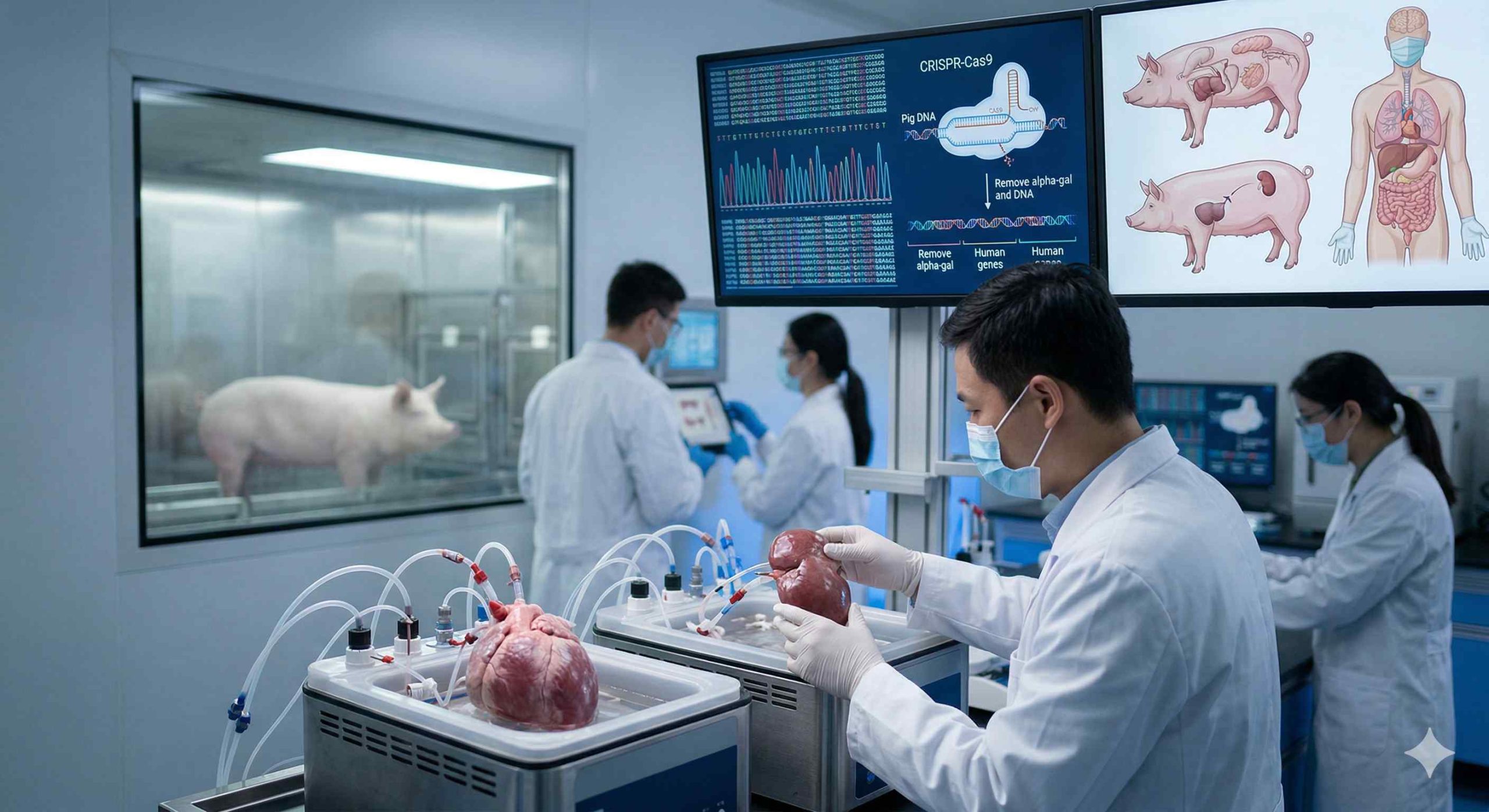
The most significant hurdle in xenotransplantation is the aggressive response of the human immune system. When a standard pig organ is connected to human blood, the body recognizes it as foreign almost instantly. This triggers hyperacute rejection, and this process can destroy the transplanted tissue within mere minutes4. The culprit is a specific sugar molecule found on the surface of pig cells called alpha-gal5. Human antibodies attack this molecule immediately, and this leads to massive inflammation and blood clotting.
To solve this, scientists use CRISPR-Cas9 technology to “knock out” the genes responsible for producing alpha-gal5. By removing these molecular triggers, the organ becomes more “human-friendly” and less likely to provoke a sudden attack. Furthermore, researchers add human genes to the pig genome, which helps to regulate blood clotting and immune responses.
Recent experiments with brain-dead recipient have shown that these edited kidneys can function for several weeks6. They produce urine and filter toxins just like a healthy human organ would. Although these are short-term studies, they provide the proof of concept needed for full clinical applications. Each successful clinical trial brings us closer to a future where organ rejection is managed through genetics rather than just immunosuppressive drugs.
The genetic engineering process for donor pigs
Producing a suitable donor pig requires advanced molecular biology to modify its genetic code for medical compatibility; it’s far more than just traditional breeding7.
- Scientists first identify the specific porcine genes that cause immune reactions or carry potential viral risks.
- They use gene-editing tools to disable these problematic sequences, and this way the donor cells lose their foreign identity.
- Researchers then insert human protective genes into the porcine DNA to prevent inflammation and promote vascular health.
- These edited nuclei are transferred into pig egg cells to create a genetically modified embryo.
- The embryos are implanted into a surrogate sow, and she eventually gives birth to a litter of “humanized” piglets.
- These piglets are raised in ultra-sterile facilities called designated pathogen-free (DPF) units, and this ensures that they do not carry any hidden pathogens.
Addressing the risk of zoonotic infections
One of the primary concerns with animal organs is the potential transmission of infectious diseases to humans. Pigs naturally carry porcine endogenous retroviruses, which are embedded directly into their genetic code8. While these viruses are usually harmless to pigs, they could theoretically mutate and infect human recipients—a risk that created significant hesitation in the medical community during the early years of research. However, scientists can systematically deactivate all copies of these viral threats at the source using the same CRISPR technology, thereby clearing a major hurdle for clinical progress8.
Furthermore, as already mentioned, the donor pigs are kept in DPF units, which prevents these animals from ever coming into contact with common farm diseases9. Regular screening of the donor animals and the human recipients is also a vital part of the protocol10. If a new virus were to emerge, early detection would allow for immediate quarantine and treatment. By employing multiple layers of safety, a strong barrier is created to protect against unforeseen biological dangers.
Current clinical breakthroughs in heart and kidney transplants
In recent years, we have witnessed remarkable milestones in the field of porcine organ transplantation. These cases involve patients who had no other remaining medical options, and their courage has paved the way for others.
The first human porcine heart transplant
In 2022, a patient with terminal heart disease received a genetically modified pig heart in a historic surgery. The organ functioned well for several weeks, and it proved that a porcine heart could support human circulation. While the patient eventually passed away, the insights gained from his case were invaluable to researchers. Scientists discovered that latent porcine cytomegalovirus had evaded initial screening, and this way the need for more rigorous viral monitoring was revealed11. This discovery helps to improve future surgical outcomes by ensuring donor organs are free from hidden pathogens. This bold step proved that the mechanical and physiological hurdles of xenotransplantation could be overcome.
Porcine kidney success in decedents
Surgeons have also successfully attached pig kidneys to brain-dead patients to test their filtration capabilities6. In several instances, the kidneys began producing urine immediately, and they maintained normal creatinine levels for the duration of the study. This success suggests that pig kidneys could soon replace traditional dialysis for many suffering from end-stage renal disease. Because dialysis is incredibly physiologically demanding, this alternative helps us to understand how we can significantly improve a patient’s quality of life by reducing the constant strain on their system.
Ethical considerations and public perception
As with any transformative technology, xenotransplantation raises various ethical questions that society must eventually answer.
Some people have concerns about the welfare of the animals used in these medical programs12. They argue that breeding pigs solely for their organs is a violation of their intrinsic rights. Conversely, many ethicists point out that we already use pigs for food on a massive scale. Using them to save human lives is seen by many as a higher and more noble purpose.
Religious considerations are central to the global adoption of this technology, as some cultures strictly avoid porcine contact12. However, many religious leaders have suggested that the “law of necessity” applies when a life is at stake. This ongoing dialogue is essential for creating a framework that respects diverse beliefs.
Public perception is influenced by discomfort with combining human and animal biology13. For some, receiving an animal organ is psychologically difficult. Clear communication about benefits and safety can reduce concerns, and greater acceptance is likely as successful cases increase.
The future of bioengineered “off-the-shelf” organs
The ultimate goal of xenotransplantation is to provide “off-the-shelf” organs that are ready whenever a patient needs them. This shift would turn a rare, tragic search for a donor into a predictable and manageable medical procedure, supported by tools like immunophenotyping to monitor immune‑rejection markers.
In the future, hospitals might keep a supply of cryopreserved or fresh porcine organs for emergency use. Such a system would be particularly beneficial for trauma victims who need an immediate transplant to survive.
Integration with other technologies, such as 3D bioprinting and regenerative medicine, will further enhance this burgeoning field14. We might see pig organs used as biological scaffolds, and then these structures could be seeded with a patient’s own stem cells. This hybrid approach would further reduce the risk of rejection, and it would create a truly personalized organ.
Furthermore, artificial intelligence can help in predicting the best genetic matches between a donor pig and a human recipient14. This predictive power helps us to understand how to maximize organ longevity and minimize the risk of rejection for each individual patient.
By 2030, it’s expected that specialized facilities will follow regulations as rigorous as those in advanced pharmaceutical laboratories. Transitioning from research to real-world procedures takes patience, accuracy, and a strong commitment to safety. Ongoing monitoring of patients’ long-term health is crucial to making these treatments widely available.
In the end, pigs could quietly play a key role in a medical breakthrough that saves many lives around the world; this progress helps us to understand how cross-species innovation can solve the global shortage of donor organs.